AI content money guide
The Hashtag & Caption Playbook
Every platform pretends its algorithm is a mystery. It isn't. Between publicly-confirmed guidance (Adam Mosseri on Instagram, TikTok's Creator Portal, Meta's Threads FAQ) and community-measured data from tools like Later, Hootsuite, Metricool and Buffer, we know almost exactly how many hashtags to use, what caption length converts, and when to hit publish. This is the copy-paste playbook — one section per platform. Save the infographic above, then read below for the copy-and-example version.
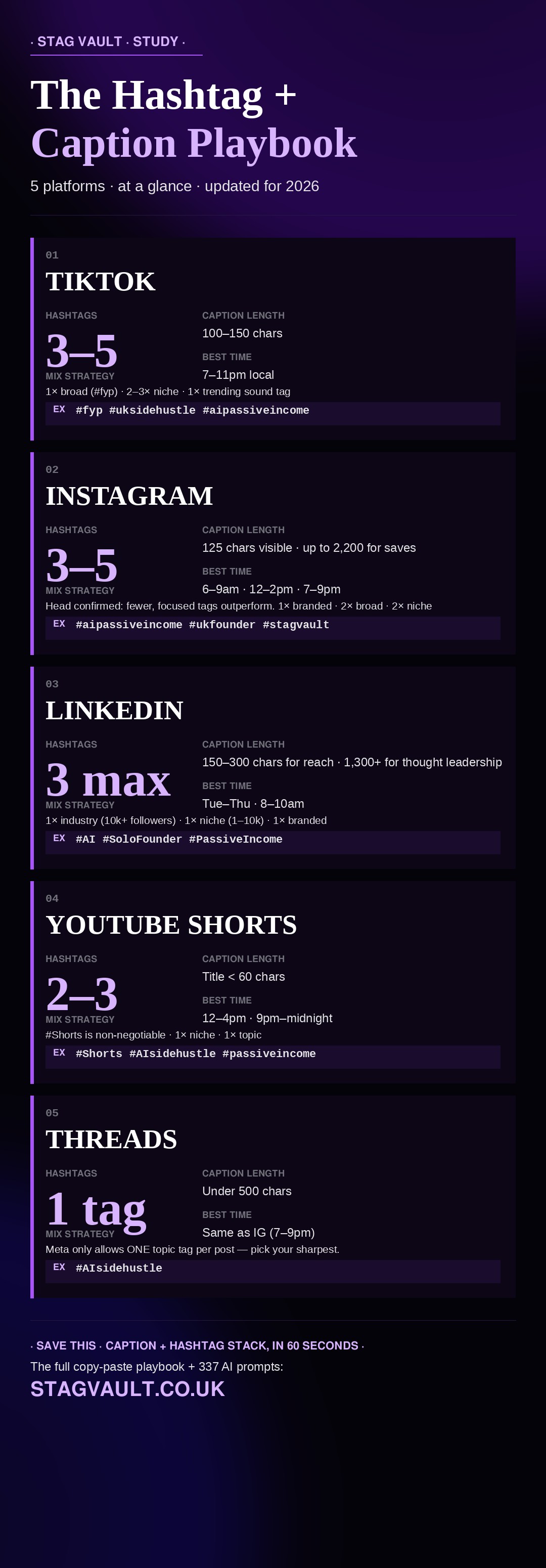
1. TikTok — 3 to 5 hashtags, hook in the first 40 characters
TikTok's For You Page uses a two-stage ranker: a broad candidate-generation pass (where hashtags help you enter the pool) and a fine ranker (where watch-time and completion decide who sees you). Too many hashtags confuse the candidate generator; too few and you don't get sampled at all. 3–5 is the empirically-observed sweet spot from the largest creator datasets.
- Optimal hashtag count: 3–5. More than 5 dilutes discovery.
- Mix: 1× broad discovery tag (#fyp / #foryou), 2–3× niche, 1× trending sound tag from the video's audio.
- Caption sweet spot: 100–150 characters. Feed cuts off after ~40 chars — front-load the hook.
- Best post time: 7–11pm local (aligned with UK, US-East, and AU peak scroll windows).
- Search-hashtags matter more than they used to: TikTok's search-based ranking (rolled out globally 2024–25) now surfaces videos via keyword match in the caption + hashtags. Treat them as SEO, not decoration.
2. Instagram — 3 to 5 hashtags (Mosseri confirmed), saves are the #1 signal
Instagram's ranking model in 2026 optimises for retention + save-rate over impressions. Saves signal 'reference value' to the algorithm, which then re-shows the post to your followers over the next 7 days, boosting cumulative reach. Hashtags only get you into the pool — saves keep you in it.
- Optimal hashtag count: 3–5. Adam Mosseri (Head of Instagram) publicly confirmed in 2024–25 that fewer, focused hashtags now outperform 30-tag stacks.
- Mix: 1× branded (your name/handle as a hashtag), 2× broad (100k–1M posts), 2× niche (<100k posts).
- Caption: 125 characters visible before the '…more' cut-off. Full length up to 2,200 chars.
- Best post time: 6–9am, 12–2pm, or 7–9pm local — three tight windows that hit commute + lunch + evening.
- Saves are the strongest algorithmic signal in 2026. Every caption should end with an implicit or explicit reason to save.
3. LinkedIn — 3 hashtags maximum, first 2 lines decide the click
LinkedIn's feed uses a two-hour 'golden window' — if your post gets strong dwell-time and comments in the first two hours, it gets amplified for the next 24. Hashtags help LinkedIn categorise you but they're a much weaker signal than dwell-time and reply-depth. Prioritise a hook that stops the scroll and a question that triggers a reply.
- Optimal hashtag count: 3 maximum. More than 3 tanks reach because LinkedIn's model treats hashtag-stuffing as spam.
- Mix: 1× industry tag (10k+ followers — e.g. #AI, #Marketing), 1× niche tag (1k–10k followers — e.g. #SoloFounder), 1× branded (your company).
- Caption: 150–300 chars for maximum engagement. 1,300+ chars only for genuine thought-leadership posts where you can hold attention.
- First 2 lines are the entire game — they decide whether users click '…see more'. If they don't click, LinkedIn shows the post to nobody else.
- Best post time: Tuesday–Thursday, 8–10am UK/EU or 8–10am ET. Weekends and Fridays: dead.
4. YouTube Shorts — hashtags belong in the title, #Shorts is non-negotiable
YouTube Shorts uses a hybrid of Shorts-shelf ranking and semantic-search matching. Hashtags in the title feed both systems; hashtags in the description only feed one. Ranking = watch-through % first, hashtag relevance second — so a punchy title + hook matters 10× more than a long tag list.
- Optimal hashtag count: 2–3 in the title (yes, in the title — not the description).
- Mix: #Shorts (mandatory for Shelf inclusion) + 1 niche + 1 topic tag.
- Title cap: 60 characters. Front-load the keyword.
- Best post time: 12–4pm and 9pm–midnight local (aligned with lunch and 'one more before bed' scroll patterns).
- Description hashtags still count, but they're a weaker signal than title hashtags in Shorts' ranking model.
5. Threads — one topic tag, reply-bait > hashtags
Threads is optimising for daily-active-users to catch Twitter/X, so its ranker heavily rewards content that drives replies (the metric Meta most needs to prove Threads is 'alive'). Hashtags in Threads are almost cosmetic — reply-count is the real currency.
- Meta only allows ONE 'topic tag' per Threads post (as of 2025) — pick your sharpest.
- Caption cap: 500 characters. Anything longer gets truncated with a '…more' link.
- Threads' algorithm is 90% engagement-based — replies are the single strongest signal.
- Best post time: same as Instagram (6–9am, 7–9pm) — the two platforms share graph signals.
- Topic tags work more like Twitter's old topic system than Instagram hashtags — they're for search + Explore, not for pool discovery.
6. The universal caption formula — regardless of platform
Every platform's ranker rewards the same 3 things in some weighted combination: (1) watch-through / dwell-time, (2) engagement (save, reply, share), (3) predicted retention on next scroll. A tight hook + a specific ask + the correct hashtag stack triggers all three at once. Everything else is decoration.
- Line 1 (hook): 40 chars max. State the outcome or contrarian claim.
- Line 2 (setup): 1 sentence of context — who this is for.
- Lines 3–5 (payoff): the specific tactic, framework, or insight.
- Line 6 (CTA): save / reply / follow — one specific ask.
- Line 7 (hashtags): platform-specific count from the sections above.