
The 5-Step Job Search System to Get Your Dream Job
A complete blueprint for landing offers — from optimising your resume to negotiating your final number — with AI doing the heavy lifting.
 Written by
 - Published:
- Last reviewed:
- Last updated:
AI tools assisted with drafting and structuring this article. The author selected the topic, edited the text and is responsible for the published version. See our editorial method and correction policy.
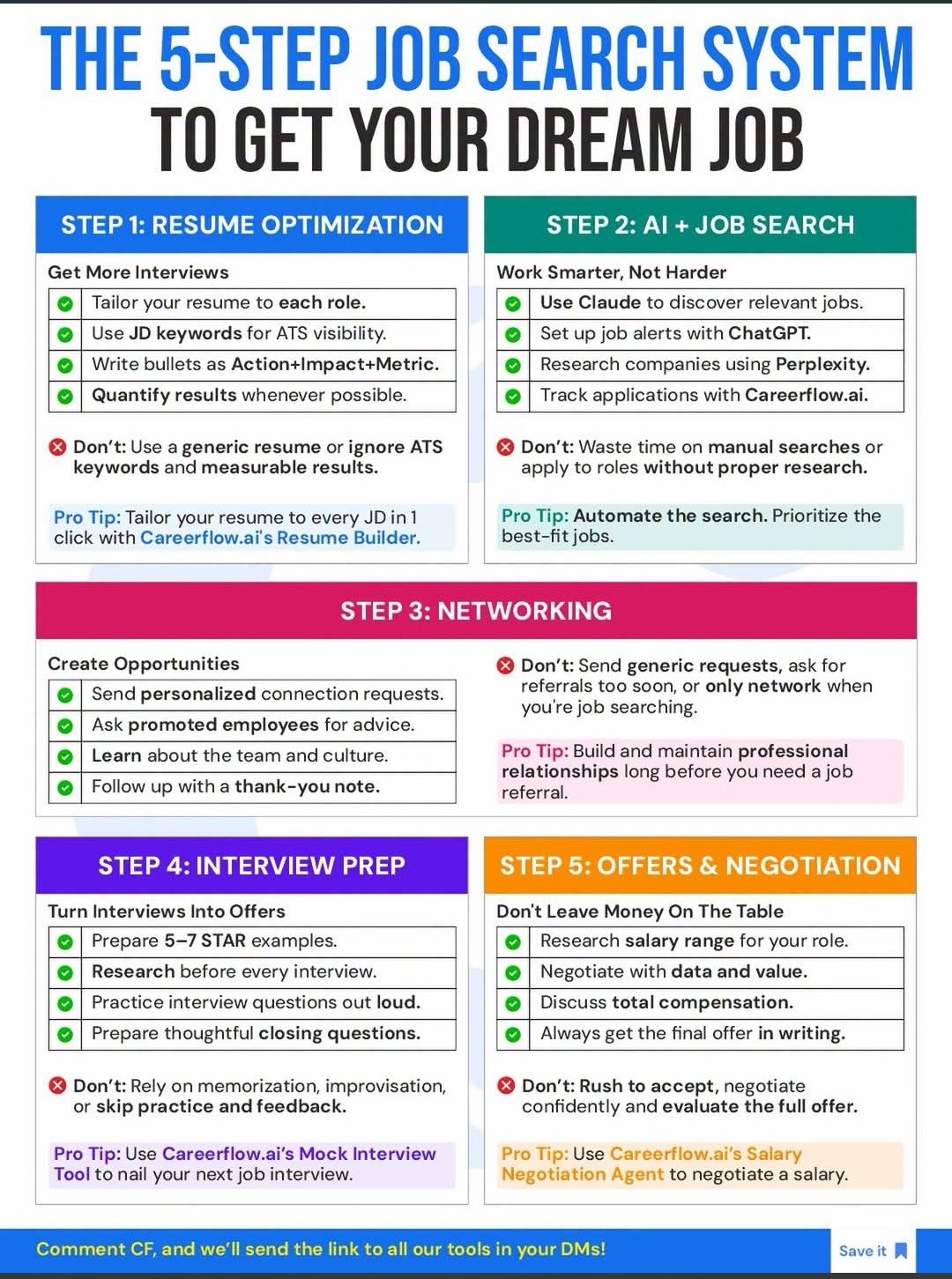
Original framework by Careerflow.ai
Job hunting in 2026 isn't about applying to 200 roles a week — it's about doing 20 well. This 5-step system covers the entire arc: optimising your resume to beat ATS filters, using AI to surface the right roles faster, building genuine professional relationships, prepping interviews that actually land offers, and negotiating final compensation with data instead of hope. Each step has a Do, a Don't, and a Pro Tip. Read it, screenshot it, work it.
Resume Optimisation · Get more interviews
- Tailor your resume to each role.
- Use JD keywords for ATS visibility.
- Write bullets as Action + Impact + Metric.
- Quantify results whenever possible.
Use a generic resume or ignore ATS keywords and measurable results.
Tailor your resume to every JD in 1 click using a tool like Careerflow.ai's Resume Builder — saves hours and meaningfully boosts ATS pass-through.
AI + Job Search · Work smarter, not harder
- Use Claude to discover relevant jobs.
- Set up job alerts with ChatGPT.
- Research companies using Perplexity.
- Track applications with Careerflow.ai.
Waste time on manual searches or apply to roles without proper research.
Automate the search. Prioritise the best-fit jobs — 20 great applications beat 200 mediocre ones every time.
Prefer to run these inside the vault with GPT-5.2 instead of copy-pasting? Get the vault — £25 lifetime
Networking · Create opportunities
- Send personalised connection requests.
- Ask promoted employees for advice.
- Learn about the team and culture.
- Follow up with a thank-you note.
Send generic requests, ask for referrals too soon, or only network when you're job searching.
Build and maintain professional relationships long before you need a job referral. Cold outreach when you're desperate reads exactly like that.
Interview Prep · Turn interviews into offers
- Prepare 5–7 STAR examples.
- Research before every interview.
- Practice interview questions out loud.
- Prepare thoughtful closing questions.
Rely on memorisation, improvisation, or skip practice and feedback.
Use a mock-interview tool (e.g. Careerflow.ai's Mock Interview) to rehearse with real-time feedback — your weak spots will be obvious within 3 sessions.
Offers & Negotiation · Don't leave money on the table
- Research salary range for your role.
- Negotiate with data and value.
- Discuss total compensation, not just base.
- Always get the final offer in writing.
Rush to accept, negotiate without data, or evaluate only the base salary.
Use a salary negotiation tool (e.g. Careerflow.ai's Salary Negotiation Agent) to coach you through the conversation — even a 5% bump on a £60k offer = £3k more in year one alone.
Want AI to do this for you?
Stag Vault includes a full Career & Dream Job track with ready-made prompts for resume rewriting, JD parsing, behavioural interview drills, salary research, and negotiation scripts — drop-in, no setup. £25 lifetime. Pick. Paste. Profit.
Unlock the Vault