
The Hashtag & Caption Playbook
Exactly how many hashtags, which types, and how long your caption should be — on the 5 platforms that matter in 2026.
 Written by
 - Published:
- Last reviewed:
- Last updated:
AI tools assisted with drafting and structuring this article. The author selected the topic, edited the text and is responsible for the published version. See our editorial method and correction policy.
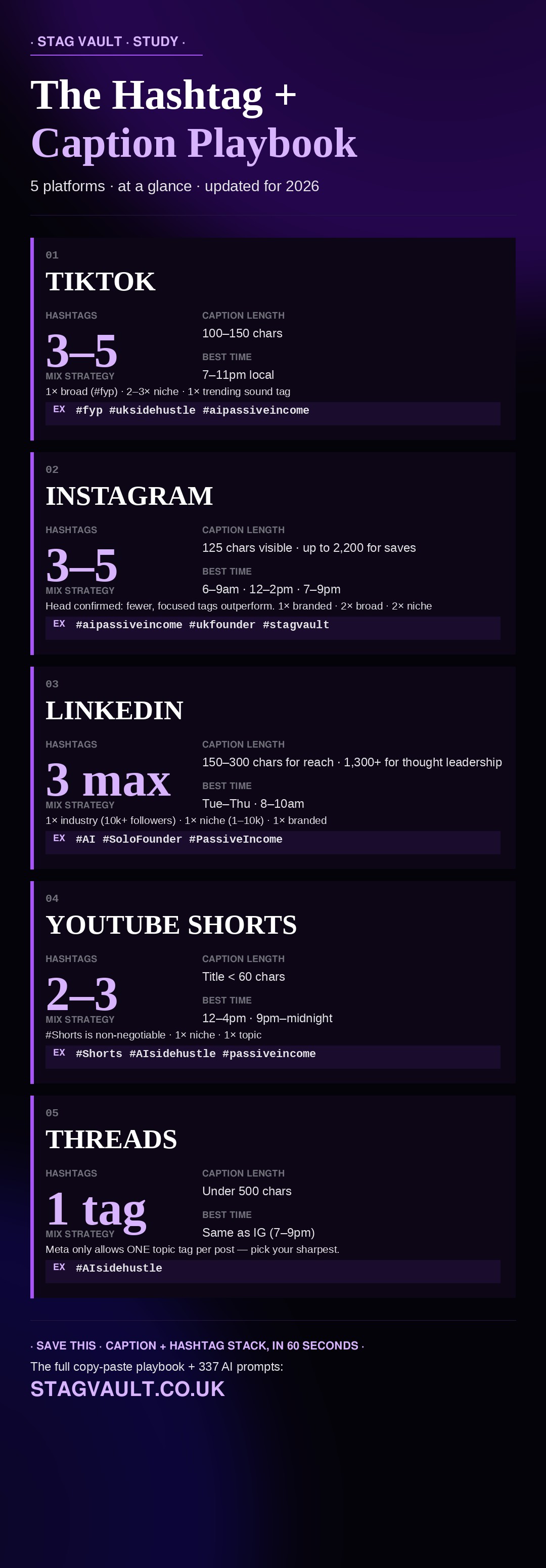
Every platform pretends its algorithm is a mystery. It isn't. Between publicly-confirmed guidance (Adam Mosseri on Instagram, TikTok's Creator Portal, Meta's Threads FAQ) and community-measured data from tools like Later, Hootsuite, Metricool and Buffer, we know almost exactly how many hashtags to use, what caption length converts, and when to hit publish. This is the copy-paste playbook — one section per platform. Save the infographic above, then read below for the copy-and-example version.
TikTok — 3 to 5 hashtags, hook in the first 40 characters
- Optimal hashtag count: 3–5. More than 5 dilutes discovery.
- Mix: 1× broad discovery tag (#fyp / #foryou), 2–3× niche, 1× trending sound tag from the video's audio.
- Caption sweet spot: 100–150 characters. Feed cuts off after ~40 chars — front-load the hook.
- Best post time: 7–11pm local (aligned with UK, US-East, and AU peak scroll windows).
- Search-hashtags matter more than they used to: TikTok's search-based ranking (rolled out globally 2024–25) now surfaces videos via keyword match in the caption + hashtags. Treat them as SEO, not decoration.
- Put the biggest promise in the first line of the caption.
- Use ONE trending sound tag if it's genuinely relevant.
- Rotate niche tags weekly — same 3 tags on every post signals bot behaviour.
Copy-paste a wall of 20 hashtags. TikTok's algorithm actively deprioritises spammy tag stacks — you look like a growth-hack account and get downranked.
Type your niche into TikTok search and let the auto-suggestions run. Those are the exact hashtags real users are searching this week. Pick 2–3 that have <500K posts (still discoverable, not saturated).
Instagram — 3 to 5 hashtags (Mosseri confirmed), saves are the #1 signal
- Optimal hashtag count: 3–5. Adam Mosseri (Head of Instagram) publicly confirmed in 2024–25 that fewer, focused hashtags now outperform 30-tag stacks.
- Mix: 1× branded (your name/handle as a hashtag), 2× broad (100k–1M posts), 2× niche (<100k posts).
- Caption: 125 characters visible before the '…more' cut-off. Full length up to 2,200 chars.
- Best post time: 6–9am, 12–2pm, or 7–9pm local — three tight windows that hit commute + lunch + evening.
- Saves are the strongest algorithmic signal in 2026. Every caption should end with an implicit or explicit reason to save.
- End captions with 'save this for later' style CTAs when the content is genuinely reference-worthy.
- Put hashtags at the END of the caption or as the first comment — both are algorithmically equal.
- Include your branded hashtag on EVERY post so followers can browse your archive.
Hide hashtags with dots or line breaks trying to be 'aesthetic' — the algorithm reads them regardless, and it makes your caption harder to scan.
The '2-broad + 2-niche + 1-branded' formula is battle-tested. If a post is 'evergreen how-to' content, swap one niche tag for a search-intent tag (e.g. #howtostartabusiness) — Instagram's Explore now ranks partially on hashtag search volume.
LinkedIn — 3 hashtags maximum, first 2 lines decide the click
- Optimal hashtag count: 3 maximum. More than 3 tanks reach because LinkedIn's model treats hashtag-stuffing as spam.
- Mix: 1× industry tag (10k+ followers — e.g. #AI, #Marketing), 1× niche tag (1k–10k followers — e.g. #SoloFounder), 1× branded (your company).
- Caption: 150–300 chars for maximum engagement. 1,300+ chars only for genuine thought-leadership posts where you can hold attention.
- First 2 lines are the entire game — they decide whether users click '…see more'. If they don't click, LinkedIn shows the post to nobody else.
- Best post time: Tuesday–Thursday, 8–10am UK/EU or 8–10am ET. Weekends and Fridays: dead.
- Start with a contrarian or specific line ('I fired my best client last month' beats 'Here are 5 tips').
- Use line breaks EVERY sentence — LinkedIn is scroll-heavy, walls of text die.
- End with a genuine question. Comments are worth 4× impressions vs. likes in LinkedIn's model.
Post links in the main body — LinkedIn suppresses posts with external links. Put the link in the first comment instead.
Add a personal photo (even a mediocre one) to organic posts — LinkedIn's algorithm heavily favours 'human' content. Text-only posts still work but native images outperform in 2026.
Prefer to run these inside the vault with GPT-5.2 instead of copy-pasting? Get the vault — £25 lifetime
YouTube Shorts — hashtags belong in the title, #Shorts is non-negotiable
- Optimal hashtag count: 2–3 in the title (yes, in the title — not the description).
- Mix: #Shorts (mandatory for Shelf inclusion) + 1 niche + 1 topic tag.
- Title cap: 60 characters. Front-load the keyword.
- Best post time: 12–4pm and 9pm–midnight local (aligned with lunch and 'one more before bed' scroll patterns).
- Description hashtags still count, but they're a weaker signal than title hashtags in Shorts' ranking model.
- Always include #Shorts in the title — it flags your video for the Shorts shelf which has 10× the reach of the regular feed for videos under 60s.
- Match your title hashtag to trending searches on YouTube's search bar (start typing your niche + see autosuggest).
- Use vertical 9:16 with captions burned into the video — silent scroll is the default, not the exception.
Load 15 hashtags in the description hoping something sticks. YouTube ignores anything after tag #3 for ranking purposes.
Shorts with the SAME hashtag as your latest long-form video get boosted into that video's 'suggested videos' rail. Use Shorts to funnel viewers back to your long-form content.
Threads — one topic tag, reply-bait > hashtags
- Meta only allows ONE 'topic tag' per Threads post (as of 2025) — pick your sharpest.
- Caption cap: 500 characters. Anything longer gets truncated with a '…more' link.
- Threads' algorithm is 90% engagement-based — replies are the single strongest signal.
- Best post time: same as Instagram (6–9am, 7–9pm) — the two platforms share graph signals.
- Topic tags work more like Twitter's old topic system than Instagram hashtags — they're for search + Explore, not for pool discovery.
- End every post with an open question or a controversial take that begs a reply.
- Chain your own posts — reply to your first post 30 seconds later with a follow-up. Chained posts get 3× the reach.
- Post 1–2 words in the FIRST post of a chain to force taps → the tap counts as engagement.
Post the same content simultaneously on Threads and Instagram — Meta suppresses cross-posted content on Threads because it competes with X for genuinely native creators.
The 'reply-bait' format outperforms hashtags 10:1 on Threads. Format: 'Contrarian take.' [line break] 'Change my mind.' — one topic tag at the end.
The universal caption formula — regardless of platform
- Line 1 (hook): 40 chars max. State the outcome or contrarian claim.
- Line 2 (setup): 1 sentence of context — who this is for.
- Lines 3–5 (payoff): the specific tactic, framework, or insight.
- Line 6 (CTA): save / reply / follow — one specific ask.
- Line 7 (hashtags): platform-specific count from the sections above.
Write the caption FIRST, then film the video/design the carousel around it. The caption is your hook — the visual is the delivery vehicle. Most creators do this backwards.
Want the copy-paste hashtag packs?
The full Stag Vault library has 2,857 AI prompts covering the entire content lifecycle — one paid track includes 12 prompts specifically for generating hashtag stacks, captions and hooks in your voice. Copy, paste, ship.
See the Vault