
8 ChatGPT Prompts Every Marketer Should Bookmark
Save these and you'll never run out of content ideas, viral angles, or repurposing systems again.
 Written by
 - Published:
- Last reviewed:
- Last updated:
AI tools assisted with drafting and structuring this article. The author selected the topic, edited the text and is responsible for the published version. See our editorial method and correction policy.
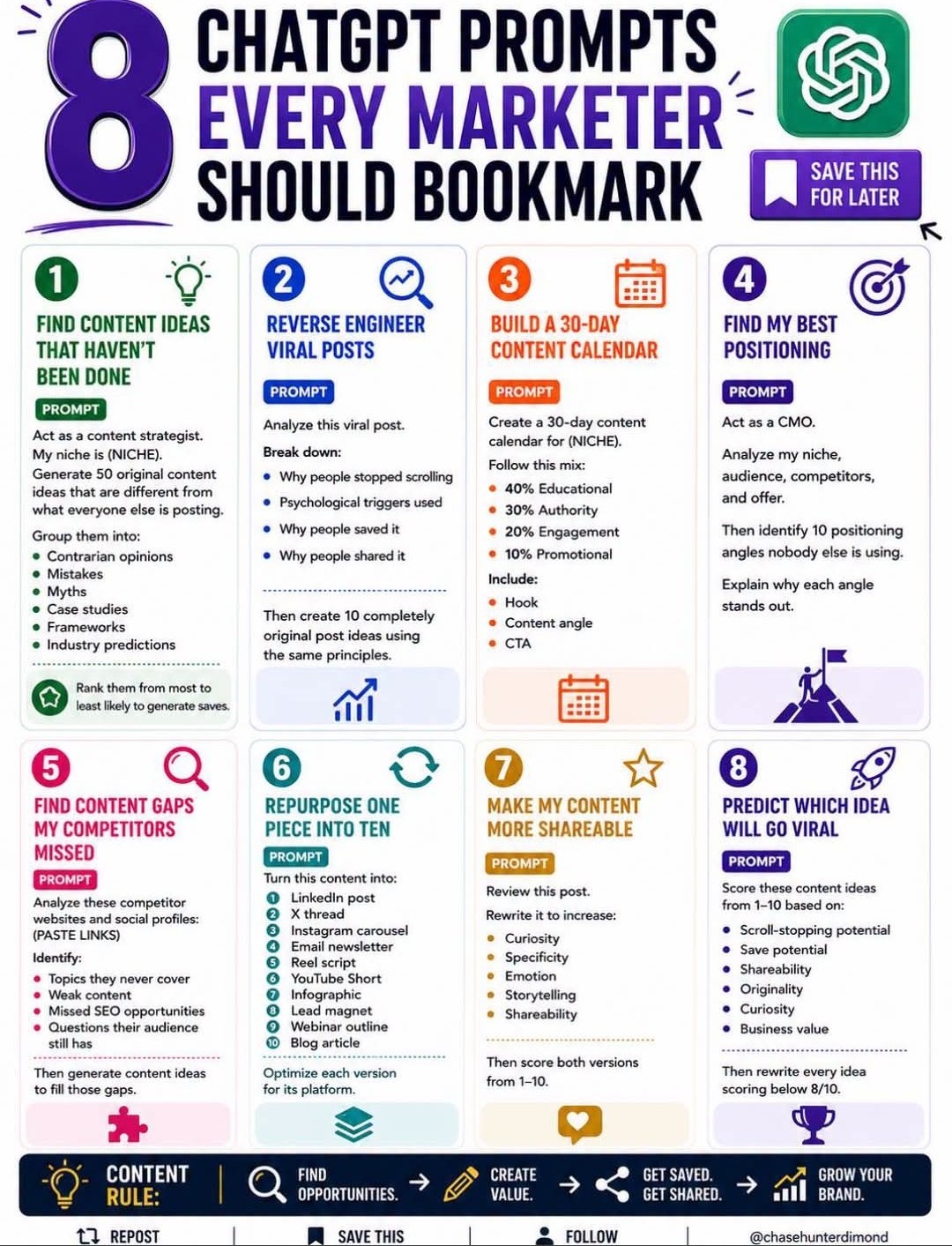
Original infographic by @chasehunterdimond
If you market anything online — product, service, or yourself — these 8 prompts cover the entire content lifecycle: idea generation, viral analysis, calendaring, positioning, competitive gaps, repurposing, shareability, and predicting what'll work. Paste them into ChatGPT, Claude, or Gemini and replace (NICHE) with your category. Or skip the copy-paste step — every paid Stag Vault member can run these in-app with GPT-5.2.
Find content ideas that haven't been done
Act as a content strategist. My niche is (NICHE). Generate 50 original content ideas that are different from what everyone else is posting.

Group them into:
• Contrarian opinions
• Mistakes
• Myths
• Case studies
• Frameworks
• Industry predictions

Then rank them from most to least likely to generate saves.
Reverse engineer viral posts
Analyse this viral post.

Break down:
• Why people stopped scrolling
• Psychological triggers used
• Why people saved it
• Why people shared it

Then create 10 completely original post ideas using the same principles.
Build a 30-day content calendar
Create a 30-day content calendar for (NICHE).

Follow this mix:
• 40% Educational
• 30% Authority
• 20% Engagement
• 10% Promotional

For each post, include:
• Hook
• Content angle
• CTA
Find my best positioning
Act as a CMO.

Analyze my niche, audience, competitors, and offer.

Then identify 10 positioning angles nobody else is using.

Explain why each angle stands out.
Prefer to run these inside the vault with GPT-5.2 instead of copy-pasting? Get the vault — £25 lifetime
Find content gaps my competitors missed
Analyse these competitor websites and social profiles: (PASTE LINKS)

Identify:
• Topics they never cover
• Weak content
• Missed SEO opportunities
• Questions their audience still has

Then generate content ideas to fill those gaps.
Repurpose one piece into ten
Turn this content into:
1. LinkedIn post
2. X thread
3. Instagram carousel
4. Email newsletter
5. Reel script
6. YouTube Short
7. Infographic
8. Lead magnet
9. Webinar outline
10. Blog article

Optimize each version for its platform.
Make my content more shareable
Review this post.

Rewrite it to increase:
• Curiosity
• Specificity
• Emotion
• Storytelling
• Shareability

Then score both versions from 1–10.
Predict which idea will go viral
Score these content ideas from 1–10 based on:
• Scroll-stopping potential
• Save potential
• Shareability
• Originality
• Curiosity
• Business value

Then rewrite every idea scoring below 8/10.
Want more like this?
These 8 prompts are a tiny slice of the 2,857 inside Stag Vault — covering 223 different ways to build with AI: from digital products and short-form video to micro-training and local-business services. Free tier lets you browse all 223 tracks and read the first 2 prompts of each. £25 lifetime unlocks everything.
Enter the Vault